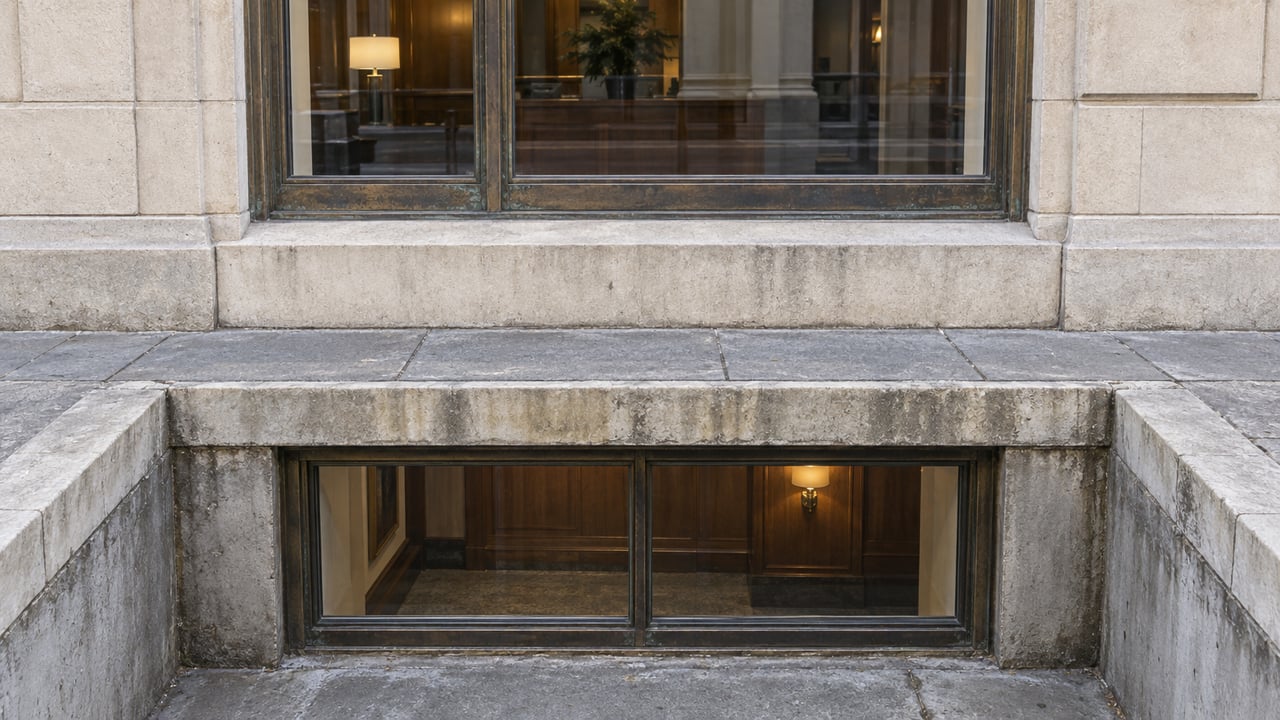
Walk into Beverly's Downtown this fall and the hostess stand isn't the destination. It's the start of a staircase. The restaurant, tucked below the Hogan Building at 901 Houston Street, sits entirely underground, a sculptural bar and dining room built into a subterranean footprint that the team behind The Mont designed specifically to separate itself from street-level downtown. A few blocks away, Musume is finishing its own return to a basement space inside the former bank building that houses the Sandman Signature Hotel, complete with the original bank vault turned into a private dining room. Two of the most talked-about restaurant openings in Downtown Fort Worth this year aren't on the ground floor at all. They're beneath it.
That's worth sitting with for a second, because it says something about the district that a list of "what's new to eat" doesn't usually capture. Downtown Fort Worth has run out of easy ground-floor space, and its most ambitious new restaurants are solving that problem by going down into buildings that already have basements worth using.
The Bank Vault That Took Two Years to Reopen
Musume's basement dining room existed before any of this. It was destroyed in the explosion at the Sandman Signature Hotel, and owner Josh Babb has spent roughly two years rebuilding it, this time with a different footprint. The old teller windows that once framed the space are gone, which means the lobby bar upstairs will look different too. What's coming back is a nine-course omakase experience with what's being called Fort Worth's largest sake and Japanese whiskey collection, set inside a room that used to hold a bank's cash. The reopening, targeted for this fall, isn't a new restaurant borrowing an old building for atmosphere. It's the same restaurant, rebuilt in the same vault, because that vault is still the most interesting room in the building.
A Second Basement, One Block Over
Beverly's Downtown didn't inherit its basement from a bank. It carved one out on purpose. The Hogan Building's owners, the team behind The Mont (Jeff Payne and Jason Cross of Cousin's BBQ), chose to build a 7,000-square-foot subterranean Mexican concept designed by Fort Worth firm Maven, the same studio that shaped The Mont's look upstairs. The pitch from the people building it has been consistent: a full escape from street-level downtown energy, not an accident of the building's layout. Where Musume's basement is a preserved artifact, Beverly's is a deliberate bet that Fort Worth diners will go looking for a room they can't see from the sidewalk.
Put those two next to each other and the pattern stops looking like coincidence. Downtown's ground floor is largely spoken for by banks, offices, and retail leases that turn over slowly. The basements underneath those buildings are the inventory nobody else wanted, and this year two separate restaurant groups decided that inventory was worth the buildout.
Above Ground, the Competition Goes a Different Direction
Not every new downtown restaurant is digging in. Almacén El Gallo, opening at 500 W. 7th Street in the mid-century First on 7th building, is taking the opposite approach: street level, at the western entrance to downtown, with a menu built around folded (not rolled) enchiladas, quality-cut tacos, and Mexican cantina and fonda influences from Chef Rodrigo Rivera Río, co-founder of the Michelin-starred KOLI Cocina de Origen in Monterrey. It's a highly credentialed chef choosing visibility over concealment, which suggests the basement trend isn't about downtown running short on talent. It's about specific buildings, specific owners, and specific bets on what a hidden room can do for a restaurant's reputation that a storefront can't.
Broadway 10, meanwhile, is taking the ground floor of the Deco 969 tower, the 27-story residential building anchoring what's become a genuinely steak-centric stretch of downtown. Del Frisco's, Capital Grille, Ruth's Chris, and Grace are all within walking distance, along with Wicked Butcher, Toro Toro, and Reata. Broadway 10 brings its own identity to that lineup, hand-cut steaks wood-fired over pecan, oak, and hickory, alongside a raw bar and sushi program, imported from its original Oklahoma City location. That's a restaurant choosing to compete in the most crowded part of downtown's dining map rather than avoid it.
And then there's Nikuya, the rooftop sushi bar atop The Sinclair from the owners of Wicked Butcher, where chef Alvin Chik (formerly of Uchiko and Kusakabe) runs a 16-seat enclosed sushi counter with open-air tables looking out over the same skyline that Beverly's and Musume are tunneling away from. Seats are hard to come by. Downtown's newest restaurants are pulling in two directions at once, some burying themselves in basements and vaults, others climbing as high as the roofline allows, and very few settling for the middle.
Even the comedy club is in on it. NADC Burger, the smashburger concept from professional skateboarder Neen Williams and Michelin-starred chef Phillip Frankland Lee, operates inside a downtown comedy club, meaning the Texas Wagyu smashburger with its "slightly tamed" jalapeños is available only if you're already walking through a comedy venue to get to it.
The Public Market's Long Restoration Reaches the Kitchen
If any single project explains why downtown's basements have become this valuable, it's the Fort Worth Public Market at 1400 Henderson Street. The 1930 building sat vacant from 2002 until Wilks Development bought it in 2015, and after a roughly $54 million restoration, the residential side, The Harden, officially opened in September 2025 as a 199-unit community originally aimed at active adults 62 and older. By January 2026, Wilks had reopened leasing to residents of all ages, with one-bedroom units starting at 723 square feet and $1,546 a month and two-bedrooms running past $3,000 for 1,473 square feet.
The food and beverage side is the final phase of a large restoration. Chef Jenna Kinard, known for her work at Max's Wine Dive and Jellico's, is building three concepts inside the market's 15,365 square feet of restored space under one operational umbrella with her husband Micah and Kansas City restaurateur Christian Moscoso: Madrone, an upscale Texana tasting-menu restaurant; Willow, a cocktail lounge with a premium liquor locker program; and Public Market Café & Goods, a coffee and bakery counter that leans on the building's history as a farmers market. The target opening has shifted from an original spring window to mid-2026, and as of this summer the restaurants were still ahead. Whatever the exact week it finally opens, the Public Market is proof that downtown's most valuable real estate right now isn't new construction. It's old buildings with the bones to support something people can't get anywhere else, whether that's a restored 1930s market hall or a bank vault that used to hold cash instead of a ten-top.
What's Actually Worth Walking Downtown For This Fall
Sundance Square marked the start of Hispanic Heritage Month on September 18 with its Car & Culture lowrider show, live folklorico performances, and a gallery crawl through Caravan of Dreams, Zona 7, and 400h galleries on Houston Street, free and open to the public. That kind of programming continues into the rest of the season. The Greater Sundance Night Market returns to the plaza on the first Saturday of the month, next up October 3, with more than 70 vendors, live music, and a fireworks show lighting up the downtown skyline, followed by another edition November 7.
The season builds toward the GM Financial Parade of Lights on November 22, the district's 44th year running it. This year's theme, "A Legacy of Lights," honors more than four decades of the tradition, with more than 100 illuminated floats moving along a 1.59-mile route and Kyle Birch, GM Financial's president of North American operations, serving as grand marshal. The parade itself is free. Reserved Street Seats start at $15.75 for children and $19.50 for adults through fortworthparadeoflights.org.
None of this requires a car. That's the actual throughline connecting the basements, the rooftop, the comedy club burger counter, and the parade route: downtown Fort Worth's fall calendar rewards people who are already there and willing to walk a few blocks, whether that walk ends in a stairwell, an elevator, or a folding chair on Main Street in late November.
If you're already living downtown and want a heads up the next time a restaurant opens somewhere you wouldn't expect to look, that's the kind of thing Ohlig Group tracks for the neighborhoods we work in every day.